Digitalization has changed our working world and artificial intelligence (AI) is no longer a topic of the future, but a key driver of innovation. Since ChatGPT became part of everyday life, AI has become more tangible for each and every one of us. AI plays a central role not only in text analysis, but also in image analysis and processing - including in the life sciences.
An impressive example of this is the French company INTERSCIENCE, which is taking its established colony counters to a whole new level with artificial intelligence. In this article, we take a practical look at the impact of AI with a focus on advanced colony counting scanners that are already making everyday laboratory work more efficient.
Short history of image analysis
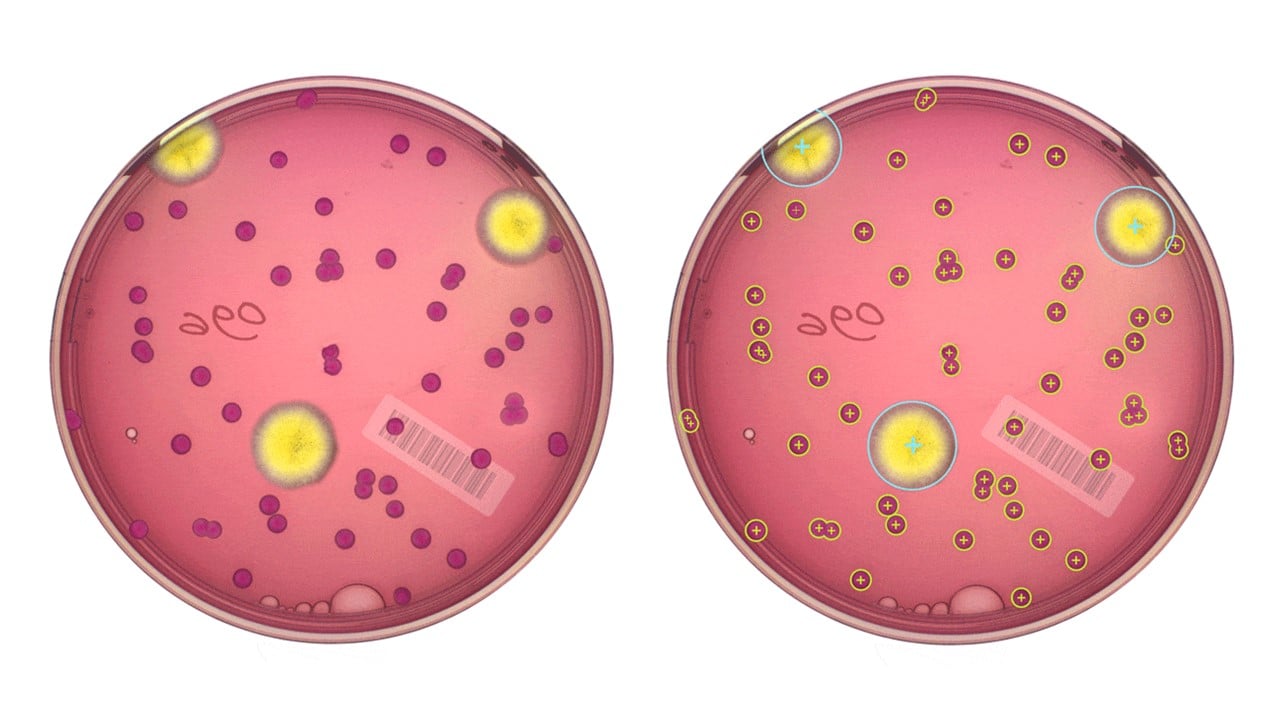
Image evaluation, also known as image processing or analysis, began in the 1960s in the medical and scientific field, e.g. for analyzing X-ray images. In the 1980s and 1990s, the field gained in importance thanks to improved computing power. From the 2010s onwards, deep learning provided a breakthrough. It is a method of machine learning, which in turn is part of artificial intelligence (AI). AI has played a growing role since 2012, especially in image recognition. Companies are increasingly using it to optimize processes and create personalized offers. Large amounts of data, powerful hardware and accessible software are driving this development. Companies such as CHROMOS Group AG (parent company of VITARIS) use modern imaging technologies for precise analyses in industry and life sciences. life sciences. A strong partner of CHROMOS is the company Basler AG.
In the past, colony counting in microbiology was mainly carried out using traditional methods of image processing and image analysis based on traditional algorithms. These methods usually worked manually or semi-automatically, for example with thresholding, edge detection or simple pattern recognition, to detect and count colonies on images. It was only with advances in the field of deep learning from the 2010s onwards that more complex and precise automated processes became possible (e.g. with Convolutional Neural Networks (CNNs). These enable significantly more efficient and precise colony counting, as they are able to reliably recognize and differentiate even in difficult image conditions.
Scan® Ai - AI-assisted precision in colony counting
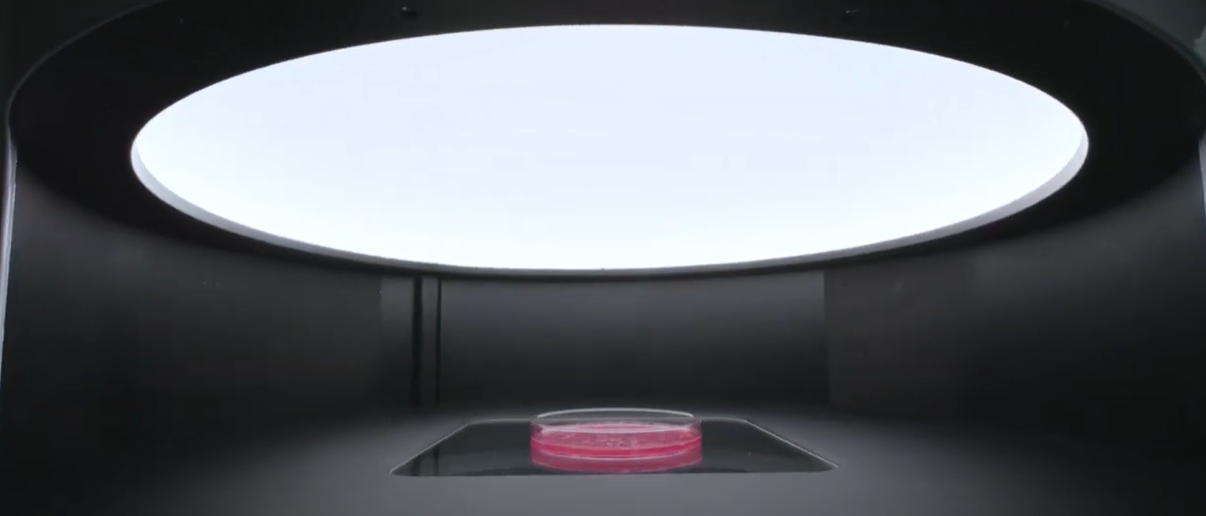
The Scan® Ai automatic colony counter from INTERSCIENCE revolutionizes microbiological analysis through the use of state-of-the-art artificial intelligence. With this system, the evaluation of Petri dishes is not only faster and more consistent, but also significantly more reliable than with conventional methods.
Thanks to its AI-supported algorithm, the Scan® Ai achieves a counting accuracy that is 25 % higher than that of standard devices. The underlying AI has been trained with over a million annotated images - based on a wide range of samples from different industries and culture media.
Features at a glance
- Extremely fast evaluation: Counts colonies within one second
- Consistent accuracy of up to 98 %
- High efficiency: up to 400 plates per hour
- Traceability: All results can be fully documented
- Precise detection: 100% of the panel surface is scanned - artifacts are automatically excluded
Wide range of applications thanks to artificial intelligence
The Scan® Ai's AI reliably distinguishes between bacteria, yeasts and molds - even with complex culture media or chromogenic plates. It recognizes different colony forms and counts reliably even with challenging samples. Special formats such as Spiral® Plating or Petrifilm™ can also be analyzed with high accuracy.
Whether classic round Petri dishes, square plates with up to 16 antibiotic disks or membrane filters from liquid samples: The Scan® Ai delivers precise and reproducible results - ideal for quality controls in a wide variety of laboratory environments.
The Scan® Ai colony counter series at VITARIS
With 20 years of experience in counting colonies INTERSCIENCE offers a comprehensive portfolio of colony counters. From manual to semi-automatic to fully automatic real-time solutions. In addition to the standard models, the range also includes AI-supported colony counters. For your Ai innovation INTERSCIENCE with the Innovation Award 2025 at the Forum Labo Paris trade fair.

Scan® 3000 Ai
Suitable for Petri dishes up to 90 mm in diameter.

Scan® 5000 Ai
Supports Petri dishes up to 150 mm in diameter and square plates with 120 mm sides.
Key features Scan® 3000 Ai
The Scan® 3000 Ai is a state-of-the-art tool for the automation and standardization of colony counting in microbiological analyses. Thanks to artificial intelligence, it offers exceptional performance and is constantly evolving to incorporate the latest technological advances. It is compatible with all sizes of Petri dishes up to 90 mm and all types of culture media.
- Smallest detectable colony size: 0.03 mm
- Counting of round Petri dishes with a diameter of 55 - 90 mm
- Cladding in cast, surface, spiral and circular form
- Reliance on chromogenic agars, Petrifilm™, MC-media Pads™, Compact Dry™, Easy Plate™, filtration membranes
- Reading inhibition zones
- AI-supported counting of colonies
Key features Scan® 5000 Ai
The Scan® 5000 Ai automates and standardizes colony counting for microbiological analysis. The power of artificial intelligence offers unparalleled performance and continuous development possibilities at the cutting edge of technological developments. It is suitable for all sizes of Petri dishes up to 150 mm and all culture media.
- Smallest detectable colony size: 0.03 mm
- Counting of round Petri dishes from 55 - 150 mm and square Petri dishes from 120 mm
- Counting the following Petri dishes: the casting plate, uniform, exponential and circular
- Counting of chromogen agar, Petrifilm™, MC-Media Pads™, Compact Dry™, Easy Plate™, membrane filter
- Hemmhof reader
- Counting colonies with AI
If you have any questions, please contact VITRIS for a consultation.
do you have any questions about this article?
We will be happy to help you.