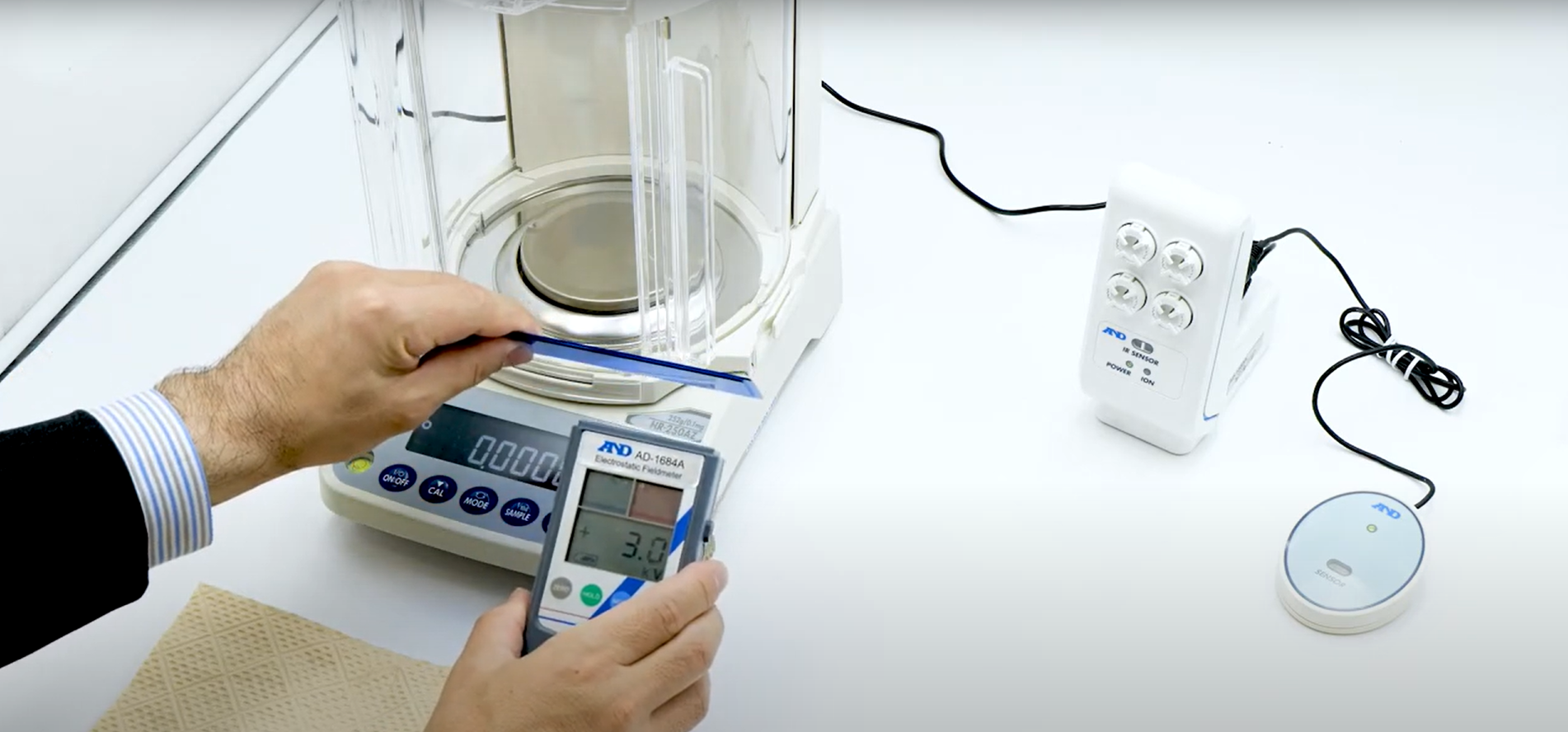
Invisible forces in the laboratory - this article focuses on the influence of electrostatic charge when using laboratory balances. In the high-precision world of modern laboratories, microscopically accurate measurement results count, especially when using laboratory balances. But this accuracy is often at stake. An invisible but real threat lurks in the form of static electricity. It can lead to falsified weighing results, inaccurate dosing and ultimately to costly misinterpretations - especially where every microgram counts.
When precision meets resistance
Static electricity is generated quickly in everyday laboratory work: when opening a plastic container, when rubbing gloves on synthetic surfaces or when removing samples with plastic tweezers. It becomes particularly critical when weighing non-conductive materials such as plastics or powders. They become electrostatically charged through friction - an effect that is as commonplace as it is problematic.
The reason: Statically charged objects generate electrostatic fields that affect the sensitive measuring cells of laboratory scales of laboratory scales. This leads to unstable or even incorrect measured values. In high-resolution analyses, for example in pharmaceutical research or materials science, this is a disruptive factor that should not be underestimated.
A real example from everyday laboratory work
Imagine a laboratory technician weighing a quantity of powder - a standard procedure. But the display on the microbalance fluctuates uncontrollably, even though there is no vibration or air movement. The cause: the powder is in a plastic container that has become statically charged when it is opened. The result: the electrostatic charge "pulls" on the load cell - and distorts the measurement result.
Such sources of error are not only annoying, they can also jeopardize the reproducibility of results, require re-measurements or render entire test series invalid.
Normally, insulators such as powder, filters and weighing paper tend to become charged at a humidity of 45% RH (relative humidity) or less and an error of a few milligrams can occur during weighing. By removing the static charge from the weighing object using so-called ionizers, it is possible to eliminate the error in the weighing value due to the charge and a correct weighing can be performed.
The helper: Ionizer from A&D Instruments

This is where so-called ionizers come into play - specialized devices that actively neutralize electrostatic charges by generating positive and negative ions. A&D Instrumentsa renowned manufacturer of high-precision weighing technology, offers two different solutions for this: the AD-1683Aan ionizer for the targeted elimination of static charges, and the compact AD-1684Aa measuring device for recording and monitoring electrostatic fields in the laboratory.
This ionizer works contactlessly via an integrated IR sensor. The static charge is neutralized within a few seconds - and the scale delivers stable, reliable values again.
The A&D ionizer can be used independently of a scale, provided that a suitable power supply unit with the correct voltage is used. A direct connection to the socket is not possible. A suitable adapter is required, ideally the original A&D power supply unit.
Main advantages of the ionizer
- Prevents measurement errors due to static charge
- Can be used independently of a scale
- Works contactless and fast
- Simple integration into existing laboratory processes
- Scientifically sound technology (corona discharge)
- Suitable for sensitive applications (e.g. pharmaceuticals, biotech, material sciences)
Scientific effect simply explained
Ionizers work on the principle of corona discharge: The ionizer eliminates static electricity by irradiating the target object with positive and negative ions, which are generated by four discharge electrodes through direct current corona discharge. These ions accumulate on the charged object and neutralize its electrostatic charge. The effect can be measured - with the scales or with the measuring device for recording and monitoring electrostatic fields.
Conclusion
Ionizers are essential tools in modern laboratory practice. They help to eliminate the uncertainties caused by static electricity and thus ensure the integrity of sensitive measurement processes. Those who work with high-precision laboratory balances should not underestimate static effects and should use an ionizer such as the models from A&D Instruments as an integral part of the weighing environment.
Because sometimes the biggest source of error is not in the fabric itself, but in the air that surrounds it. Contact us now for a consultation.
do you have any questions about this article?
We will be happy to help you.