Misconceptions and Gaps in the Design Phase, and Four Key Elements for Successful Laboratory Construction Projects
Laboratory construction projects rarely fail due to execution issues. The root causes almost always lie earlier in the process—for example, in unclear requirements, a lack of coordination between operations, planning, and engineering, or incorrect assumptions about processes. Mladen Kovacevic, founder and managing director of K-oncept Engineering GmbH and author of this article, oversees projects from the early conceptual phase through to implementation and observes recurring patterns that determine success or failure.
VITARIS has been working as a partner to laboratory planners for many years at precisely this interface and has seen firsthand how decisions made at this stage influence subsequent planning, equipment selection, and operations. This article draws on these experiences and organizes them in a structured manner. The goal is to provide planners, building owners, and operators with a common foundation for making sound decisions.
1. The real problem arises before implementation
Why Projects Don’t Fail Where It’s Visible
When a construction project fails or goes off the rails, attention almost always turns to the execution phase: the construction site, the workmanship, the contractors. The real cause, however, lies earlier in the process. Projects rarely fail during execution. They fail because of decisions made months earlier—or because of decisions that were never made.
Phases, Decision Points, and Where Errors Occur
To understand where errorsoccur, it helps to have a clear picture of the project workflow. A laboratory construction project typically goes through the following phases:
- Feasibility / Concept
- Basic Design
- Detail Design
- Execution
- Commissioning & Qualification
- Handover
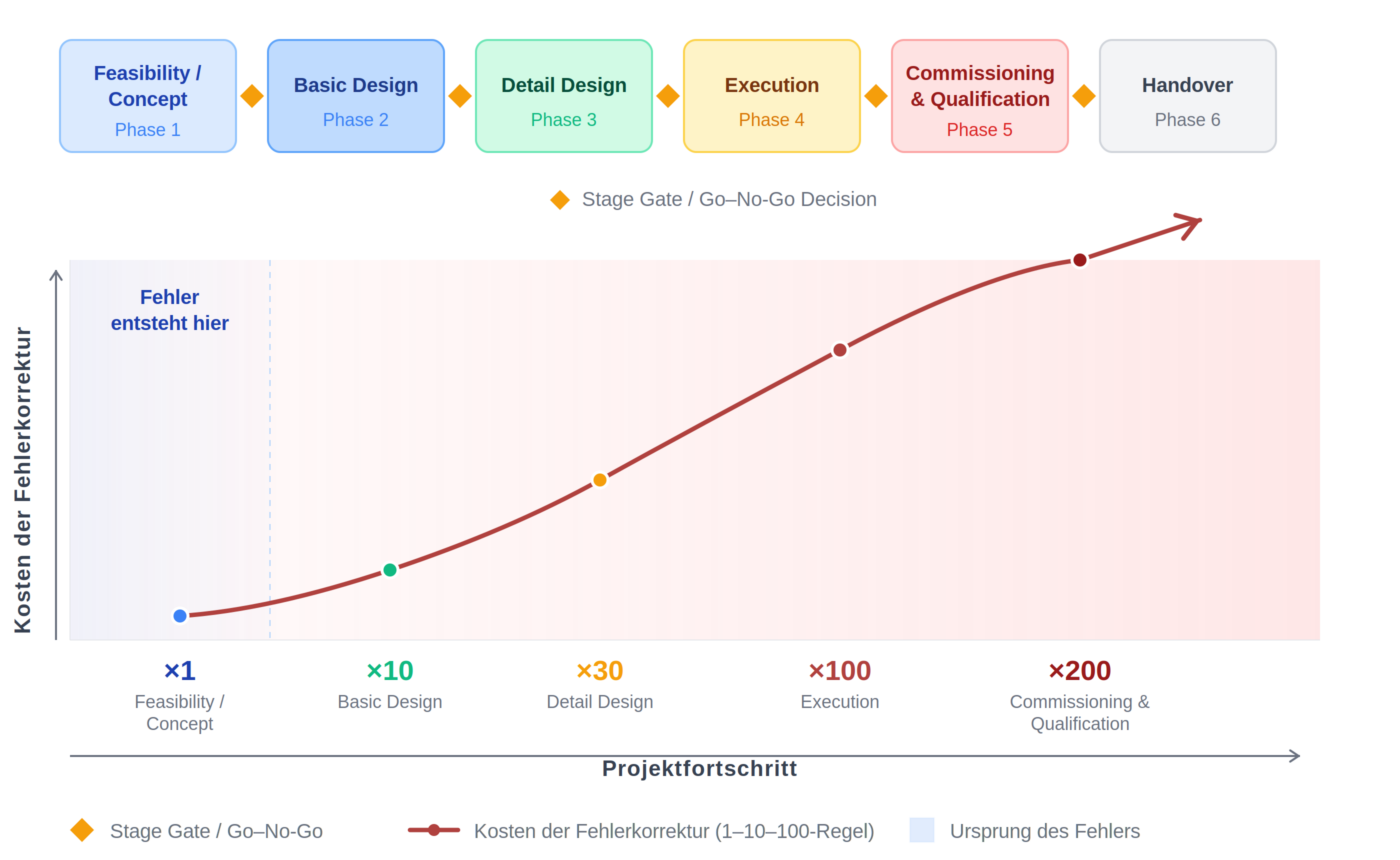
Between these phases lie decision points known as stage gates or go/no-go decisions. At these points, an assessment is made as to whether the groundwork for the next phase is sufficient. Those who fail to make consistent use of these points carry uncertainties forward into each subsequent phase. A small error in the concept phase carries over into planning, design, and implementation. What is unclear at the outset becomes a structural problem as the project progresses. Correcting it becomes more complex and expensive with each phase.
The cost of errors increases exponentially
A proven rule of thumb from engineering practice describes this relationship precisely: An error that costs 1 unit in the concept phase costs 10 in the planning phase and 100 in the implementation phase. This 1-10-100 rule is not a theoretical model, but a reality of project management. This effect is particularly pronounced in the laboratory environment. Projects are technically complex, heavily regulated, and closely interlinked. Changes immediately affect multiple systems and must simultaneously remain traceable for regulatory purposes.
2. The concept phase determines whether a project succeeds or fails
What a good concept phase achieves
The most critical stage of the project is the conceptual phase. This is where the objectives, benefits, and framework conditions are defined. Those who take this step seriously lay the foundation for a solid project. A well-grounded conceptual phase delivers the following concrete results:
- Needs Assessment and User Profile: Who works in the lab, with what substances, and in what processes?
- Feasibility study: Is the project technically, regulatory, and economically feasible?
- Risk Assessment: What uncertainties exist, and how are they evaluated?
- Budget constraints and cost-benefit analysis: Which investment is justified?
- Comparison of options: At least two or three possible solutions are compared and evaluated.
- A basis for management decision-making: clearly structured documentation that enables an informed go/no-go decision.
Common Mistakes with Long-Term Consequences
Common mistakesare easy to spot. Objectives are formulated imprecisely. The benefits remain vague. Key stakeholders are brought on board too late. The project scope is not clearly defined. Time and cost estimates are overly optimistic. Interdependencies between systems are underestimated. These mistakes remain hidden at first. They manifest as symptoms during implementation. Changes pile up, coordination becomes more complex, and the project shifts into reactive mode. What appears to be an execution problem is, in reality, a planning error.
Stakeholder Management: Who Needs to Be Involved and When?
One aspect of the design phase that is often underestimated is the early involvement of all relevant stakeholders. In laboratory construction, these typically include:
- Users: Scientists, lab technicians, and engineers; they are familiar with the actual workflows.
- Operations: Facilities Management, HSE (Health, Safety & Environment); You will be responsible for future operations.
- Quality assurance; you define the compliance requirements.
- IT – for data systems, laboratory information management systems (LIMS), and network infrastructure.
- Purchasing for strategic procurement and supplier relations.
- Project sponsor and funder for budget approval and strategic direction.
Tools such as a RACI matrix (Responsible, Accountable, Consulted, Informed) or a stakeholder map help clarify responsibilities. Structured requirements workshops ensure that all relevant requirements are identified before planning begins.
3. Complexity in laboratory construction amplifies every mistake
Regulatory Requirements, Technology, and Interfaces as Risk Drivers
Laboratory projects in the pharmaceutical industry are subject to clear stress factors. Regulatory requirements result in a high volume of documentation. Qualification and validation consistently reveal planning errors. Numerous interfaces between different disciplines increase the need for coordination. Cleanroom technology leaves little room for subsequent adjustments. At the same time, there is time pressure due to internal and external targets.
Laboratory-specific planning considerations during the conceptual phase
In laboratory construction, a number of issues must be addressed during the conceptual phase—issues that do not become relevant until later in other construction projects:
- Laboratory classes and safety levels: Biosafety levels BSL-1 through BSL-4 define protection requirements for buildings, equipment, and operations.
- Utility supply: Compressed air, technical gases, vacuum, ultrapure water (PW, WFI) – the type, quality, and distribution must be determined early on.
- Ventilation design: exhaust and supply air volumes, pressure differentials between rooms, heat recovery; these factors have a fundamental impact on the building structure and building services.
- Energy consumption and sustainability: Laboratories are energy-intensive. Sustainability goals must be incorporated into the design from the very beginning.
- Space efficiency and zoning: Which areas are designated for which activities? How are clean and dirty zones separated?
- Material, personnel, and waste follow defined routes in a regulated laboratory. These routes must be planned in advance.
- Future flexibility: Can spaces be repurposed or expanded if requirements change?
The User Requirements Specification as a Key Guiding Document
A key element is the User Requirements Specification (URS). It defines all functional and technical requirements and serves as the basis for design, construction, and qualification. Unclear requirements inevitably lead to unclear results.
A complete URS includes:
- Functional requirements: What is the system or space intended to do?
- Performance requirements: What measurable criteria must be met?
- Compliance Requirements: What regulatory standards apply (GMP, GAMP 5, FDA 21 CFR Part 11)?
- Interfaces: What other systems, rooms, or processes does this depend on?
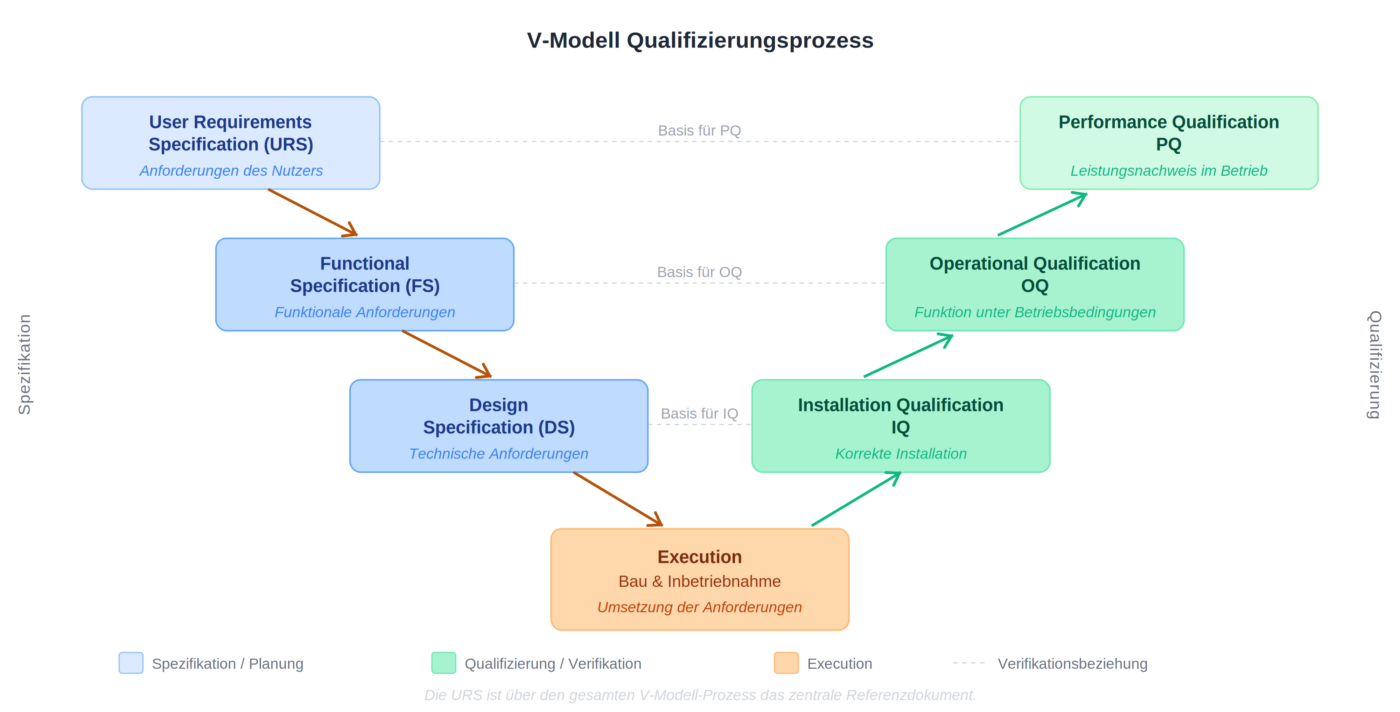
The URS is drafted by the process owner and approved by Quality Assurance. It serves as a reference document throughout the entire V-Model qualification process—from Design Qualification (DQ) through Installation Qualification (IQ) and Operational Qualification (OQ) to Performance Qualification (PQ).
Common pitfalls in URS development: Requirements are often too broadly defined, unverifiable, or overly technical and lack a user-centric focus. A lack of clear accountability during the development process is also a frequent problem. The difference between stable and unstable projects lies not in their implementation, but in the quality of these early specifications.
4. The lever is at the beginning
Project Structure and the Question: Who Plans What?
The crucial question is not whether a project is executed properly. The crucial question is whether it was properly planned. To answer this question, one must understand how a laboratory construction project is typically organized and what roles are involved:
- Client representation: Represents the interests of the owner or user in dealings with all designers and contractors.
- General planner or project manager: Coordinates all discipline-specific planners under one roof—ideal for complex projects.
- Specialist consultants: Specialized engineering firms for HVAC (heating, ventilation, air conditioning, and plumbing), electrical engineering, cleanroom technology, fire protection, and laboratory safety.
- Specialized laboratory design consultant: Provides expert guidance on regulatory, technical, and operational requirements early in the concept and planning phases.
The question of when to bring in outside expertise is particularly crucial. Those who wait until problems become apparent before consulting a specialist end up paying twice.
What Decision-Makers Should Do in Practice
If you wait until the implementation phase to start solving problems, you’re acting too late and at too high a cost. The greatest opportunities for impact lie in the planning phase. That’s where clarity, structure, and sound decisions are established. Five questions that must be answered during the planning phase of any laboratory project:
- Have the project objectives been clearly defined and approved by all stakeholders?
- Is the URS complete, verifiable, and approved by QA?
- Have all relevant stakeholders been involved?
- Has the project scope been clearly defined and confirmed through a go/no-go decision?
- Have at least two possible solutions been developed and compared?
If you're planning a lab project or reviewing an ongoing one, this is where you should start. Review the objectives, benefits, scope, and dependencies. Question assumptions before they become entrenched in the project.
Conclusion
Laboratory projects don’t fail on the construction site. They fail during the design phase due to unclear requirements, a lack of information needed to make decisions, and specialists who are brought in too late. This is not the exception. It is the rule.
Anyone who wants to set up a laboratory project professionally needs the right foundation from the very beginning: a robust URS, a well-thought-out concept, clearly defined roles, and a project partner who understands the entire process, from the initial idea to the completion of qualification. The difference between a stable and an unstable project does not lie in the budget or the schedule. It lies in the quality of the decisions that are made—or not made—early on.
Guest Author: Mladen Kovacevic – Founder & Managing Director, K-oncept Engineering GmbH
- Founded K-oncept Engineering GmbH in 2024 as an independent engineering firm serving the pharmaceutical industry
- Pharmaceutical Technologist with over 11 years of project experience in the pharmaceutical industry
- Specialist in the design of water treatment facilities and supply systems for the pharmaceutical industry
- Experienced project manager for complex engineering projects in the GMP environment
- Planning and Design of Laboratory Infrastructure for Life Sciences Companies

About K-oncept Engineering GmbH
K-oncept Engineering has extensive expertise in various areas of the pharmaceutical industry that are critical to the success of your projects: